How This Came To Be
I didn't start with Simmel. I didn't start with Moltmann. I started with frustration.
Years of watching organizations make the same mistakes:
- Good people trapped in bad structures
- One person carrying too much, burning out, leaving
- Dissent going silent because it wasn't safe to speak
- Succession becoming impossible because everything depended on one leader
I kept asking: What if we built it differently from the start?
Not "how do we fix this leader?" but "what structure makes this impossible?"
The answer kept pointing to three:
- Three people, not one
- Three voices, recorded
- Three perspectives, required
So I built it. On paper. In my head. In conversations.
Then I did what you should always do: I researched.
And that's when I nearly stopped.
Because I kept finding pieces of what I'd built already existed:
- Simmel wrote about triangles in the 1890s
- Moltmann, Volf, LaCugna developed Social Trinitarianism
- Greenleaf published servant leadership in the 1970s
- Supreme Courts record dissenting opinions
- Distributed leadership research describes what works
My first thought: I'm not original. This is all borrowed.
My second thought: Maybe I should abandon this.
But then I realized something:
None of them put it together.
Simmel described triangles — he didn't build decision procedures.
The Social Trinitarians wrote about relational theology — they didn't design organizational structures.
Greenleaf gave ethical guidance — he didn't enforce it architecturally.
Courts record dissent at the apex — not systematically at all levels.
Distributed leadership describes what happens — it doesn't prescribe the minimum viable unit.
The synthesis is new. The implementation is new. The combination is new.
So I didn't abandon it. I documented it. Honestly.
This page shows you what came before. What we inherited. What we added.
Because the innovation isn't in inventing components. It's in assembling them into something that works.
If you see gaps in this lineage — ideas we should acknowledge that we've missed — please contact us. Intellectual honesty is a core value of this framework.
Intellectual Honesty
Triangle does not claim to invent its component ideas. This framework stands on shoulders. The innovation is in the synthesis — combining existing insights into an implementable organizational system.
This page documents the lineage clearly so you can see:
- What we inherited
- What we added
- Why the combination matters
Foundation 1: Triangle Stability (Sociology)
Georg Simmel (1858-1918)
German sociologist, pioneer of microsociology
Key Work: The Sociology of Georg Simmel (1908), particularly the chapter on dyads and triangles
What He Established:
- Dyads (two-person groups) are inherently unstable — collapse when one person leaves
- Triangles (three-person groups) are the smallest stable social unit
- Triangles create structural possibilities dyads cannot: mediation, coalition, dissent
- The third person transforms the group's dynamics fundamentally
What He Didn't Prescribe:
Simmel described triangles. He didn't prescribe them as mandatory organizational structure. His work was analytical, not design-oriented.
What Triangle Adds:
- The triangle as required minimum unit for all significant decisions
- Four-step process (Frame, Vote, Record, Move) with facilitator selection
- Consensus-first voting with 2/3 majority and recorded dissent
- Dynamic authority within the triangle (not just three equal votes)
Foundation 2: Social Trinitarianism (Theology)
Moltmann, Volf, LaCugna, Boff (20th century)
Protestant, Orthodox, and Catholic theologians
Key Works:
- Moltmann, The Trinity and the Kingdom of God (1981)
- Volf, After Our Likeness (1998)
- LaCugna, God for Us: The Trinity and Christian Life (1991)
- Boff, Trinity and Society (1988)
What They Established:
- The Trinity is not just doctrine but a model for relationality
- Three persons, distinct centers of consciousness, united in loving relationship
- Human communities should reflect this divine pattern (perichoresis)
- Unity without uniformity; distinction without division
What They Didn't Prescribe:
Social Trinitarians wrote about the Trinity as model for community. They didn't design specific organizational decision-making procedures.
What Triangle Adds:
- Operational mechanisms that mirror perichoresis (recorded dissent = distinction preserved in unity)
- Consensus-first voting as practical expression of "unity without uniformity"
- Theological foundation made implementable
- Biblical witness pattern for challenge rule (two or three witnesses)
Foundation 3: Servant Leadership (Ethics)
Robert K. Greenleaf (1904-1990)
AT&T executive turned management consultant
Key Work: The Servant as Leader (1970)
What He Established:
- Leaders should serve first, lead second
- The best test: "Do those served grow as persons?"
- Leadership as stewardship, not ownership
What He Didn't Prescribe:
Greenleaf's framework is ethical guidance without architectural enforcement. A "servant leader" can still be a solo decision-maker who happens to be kind about it.
What Triangle Adds:
- Structural constraints that make servant leadership inescapable
- Three people, not one — power is distributed by design
- Recorded dissent — the leader's view can be overruled
- Dynamic authority — the "servant leader" doesn't always decide
Foundation 4: Distributed Leadership (Research)
Spillane, Gronn, and others (2000s-present)
Organizational and education researchers
Key Works:
- Spillane, J. P. (2006). Distributed Leadership. Jossey-Bass.
- Gronn, P. (2002). "Distributed leadership as a unit of analysis." Leadership Quarterly.
What They Established:
- Leadership works best when stretched across multiple actors
- "Leader plus" model — leadership activities distributed across the organization
- Context matters — different situations need different leaders
What They Didn't Prescribe:
Distributed leadership research describes what happens in effective organizations. It doesn't prescribe the minimum viable unit (triangle) or specific decision mechanisms.
What Triangle Adds:
- The triangle as the atomic unit of distributed leadership
- Specific mechanisms for distributing authority within the unit
- Accountability structures that distributed leadership often lacks
Foundation 5: Recorded Dissent (Governance)
Supreme Courts, Corporate Boards, Parliamentary Systems
Established governance practice
Examples:
- U.S. Supreme Court majority + dissenting opinions
- UK House of Lords recorded votes
- Some corporate boards (required for major decisions in certain jurisdictions)
What Exists:
Some institutions do record dissent. The practice is established in judicial systems and some governance contexts.
What's Missing:
Recorded dissent is typically limited to high-level decisions only, not systematic across all organizational levels, not paired with triangleic structure or dynamic authority.
What Triangle Adds:
- Recorded dissent as default for all significant decisions
- Dissent as institutional memory, not just historical record
- Dissent tracking linked to authority shifts (vindicated dissent increases future authority)
The Synthesis: What's Actually New
| Element | Source | Triangle Innovation |
|---|---|---|
| Triangle as stable unit | Simmel (sociology) | Mandatory for all significant decisions |
| Relational model | Social Trinitarians (theology) | Four-step process (Frame, Vote, Record, Move) with facilitator |
| Service ethic | Greenleaf (ethics) | Structural enforcement (can't hoard power) |
| Distributed authority | Org research (management) | Minimum unit specified (triangle) |
| Recorded dissent | Governance practice | Systematic at all levels, linked to authority |
| Lock & Forward | governance / decision theory | Decisions lock once complete, forward-only progression |
| Challenge rule | Biblical witness pattern | Two non-originating triangles challenge a lock |
| AI dependency tool | Emerging technology | Suggests dependencies, flags conflicts, humans confirm |
The Complete Protocol
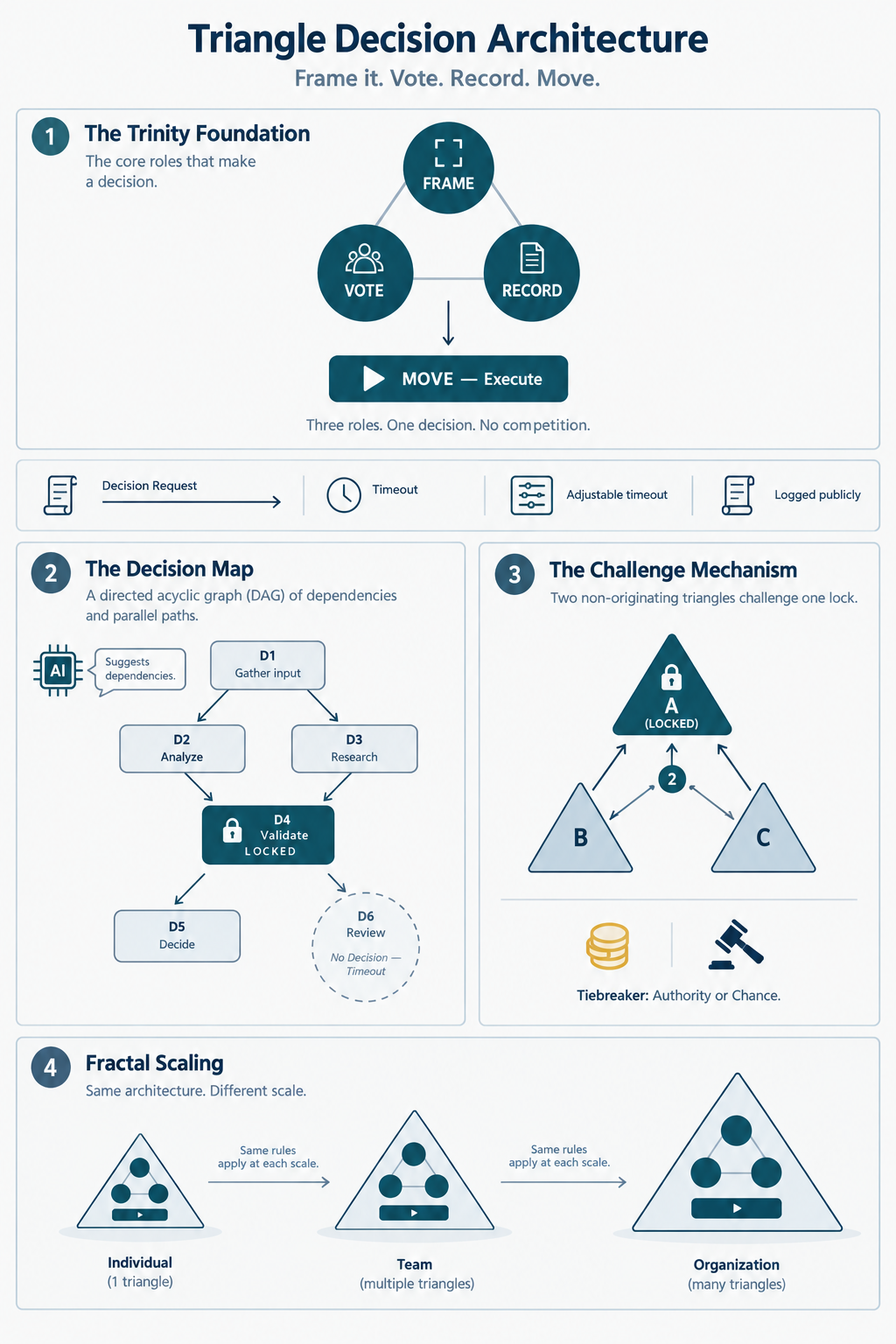
Visual summary of the full Triangle Decision Architecture protocol
The innovation is the combination. Individually, none of these elements is new. Together, they create an organizational system that prevents benevolent dictatorship, preserves dissent intelligence, enables dynamic authority, and keeps AI in its proper role.
Why This Matters
For Christian organizations: The theological foundation is explicit. You can implement Triangle as an expression of Trinitarian relationality and servant leadership.
For secular organizations: The sociological and management foundations stand on their own. You can implement Triangle for structural stability without theological commitment.
For both: The framework is honest about its sources. You're not adopting someone's proprietary methodology. You're implementing a synthesis of established insights with new operational mechanisms.
Citing This Framework
The framework is released under CC BY-NC 4.0 — attribution required, non-commercial use permitted.