Why This Exists
The Problem
You've been in that meeting:
- The decision that needed making was too big for one person
- Someone disagreed but said nothing
- Six months later, it went wrong
- The dissent was there — but nobody recorded it
This is not a people problem. It's a structure problem.
One person decides → they burn out, or worse, they're wrong and nobody told them.
Everyone agrees → nothing moves, or dissent goes silent to keep the peace.
Speed or honesty. Pick one. Or so we're told.
The Solution
Triangle gives you both.
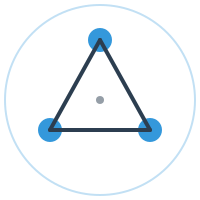
Three people. Not one. Not a committee. Three. One of them is chosen as facilitator — first among equals, running the process.
- Frame → clarify the question before anyone speaks
- Vote → aim for consensus, 2/3 carries, dissent recorded
- Record → write the decision and why, no memory drift
- Move → execute, no circular re-litigation
- Lock → once complete, the decision is locked. Forward only.
That's it. Simple.
Who This Is For
You should care if:
- You lead a team — and feel the weight of carrying judgment alone
- You sit on a board — and have watched dissent disappear into unanimous votes
- You're building something to outlast you — and succession keeps you awake
- You're integrating AI — and worry about accountability when machines recommend
This is not for everyone. It's for leaders who believe structure matters more than charisma, and institutions should survive their founders.
The Promise
Triangle doesn't promise better leaders. It promises better structures for humans.
- Triangles hold their shape under pressure
- Dissent travels with the decision — disagreement is information, not noise
- Authority flows to competence, not title
- Decisions lock — no circular re-litigation
- Two independent voices can challenge a lock — witness, not majority
- Machines advise, humans decide — always
Leadership by structure, not by committee.
The Framework
1. The Triangle
Three people. One facilitator chosen from within. Small enough for accountability. Large enough for disagreement.
2. Frame → Vote → Record → Move
The four-step process. Clarify the question. Make the call. Write it down. Execute. One decision, four steps, always.
3. Consensus-First Voting
Facilitator aims for genuine consensus. When not reached, 2/3 carries. If facilitator is in minority, they represent the majority — not override it.
4. The Decision Map
A directed graph of decisions and dependencies. Some decisions depend on others. Some run in parallel. The Map makes the sequence visible.
5. Lock & Forward
Once a decision completes all four steps, it is locked. No going back. The team moves to the next decision in the sequence.
6. Challenge Rule
Two non-originating triangles can challenge a lock. Not a ratio — an absolute count of independent voices. Biblical witness pattern.
7. AI Advisory
Machines recommend dependencies, flag conflicts, suggest sequences. Humans confirm. Accountability stays human — always.
Follow Along
I'm publishing this journey publicly — the wins, the failures, the lessons. If you want to follow, here's where:
Or get in touch directly:
Join the Pilot
I'm looking for 2-3 organizations to test Triangle for 30 days. Here's what's involved:
- Form one triangle — three people for significant decisions
- Use the decision log — record votes, dissent, AI recommendations
- Weekly check-in — 15 minutes to review what's working
- Honest feedback — publish what you learn (anonymized if needed)
Cost: Nothing. The framework is free (CC BY-NC 4.0).
Time: ~1 hour/week for the 30-day pilot.
What you get: Early access to tools, direct support from me, contribution to something that could change how organizations work.